
Unveiling the Hidden Economy of Unused Stamps: Why Are Legitimate USPS Stamps Sold at a Discount?

In an era of soaring prices, even the cost of sending a letter has become a sensitive issue. With USPS adjusting postage rates multiple times, First-Class postage prices have increased year after year, leading many to notice a puzzling phenomenon:
Some third-party platforms and websites offer discount stamps at prices significantly lower than those at post offices.
If you see this price tag for the first time, nine times out of ten you’ll have these questions:
“Is this legal? Could these be counterfeit tickets? Can someone really sell something that’s practically equivalent to currency at such a low price?#8221;
To explain all this, you first need to understand a concept: the secret economy of unused postage. This is the result of the combined effects of inflation, changes in the collectibles market, corporate asset liquidation, and the Forever Stamp mechanism. The following content will break down this system to see why discounts are indeed traceable.
I. The Forever Stamp mechanism opens up discount opportunities.
The story begins in 2007. That year, the USPS introduced the Forever stamp, which had no fixed denomination.
Its rule was very straightforward: no matter how much you paid for it initially, it was always equivalent to one ounce of current First-Class postage.
USPS stamps in bulk 10 years ago at a cheaper price, their “postage effectiveness” would have increased in value today as postage rates have risen.
A simple formula can explain why discount stamps appear:
purchased a large quantity of Forever stamps in 2012 at a price of $0.45 each.
Current postage: A stamp of equivalent value is now worth approximately $0.73.
Distribution method: These early buyers will sell their old inventory to the market at a price lower than the current price.
Result: Consumers can buy fully valid, genuine tickets at a lower price.
When such price differences appear in the market, a stable and healthy discount supply chain is naturally formed.

II. After the collecting boom subsided, a vast “stamp legacy” flooded the market.
The United States once experienced a period of widespread stamp collecting. Many families amassed astonishing collections of stamp sheets, blocks of four, and rolls, neatly sealed in albums.
As the hobby waned, these collections were often inherited by the next generation. However, the reality is that the vast majority of stamps printed after the 1940s were produced in massive quantities and lack collectible value.
Therefore, when these families try to sell their collections, they are often only allowed to do so for “mailing purposes.”
From an industry perspective, this is another source of discount stamps:
Dealers buy up these stamps that have been dormant for decades in bulk, take them over at prices far below face value, and then put them into circulation on the secondary market.
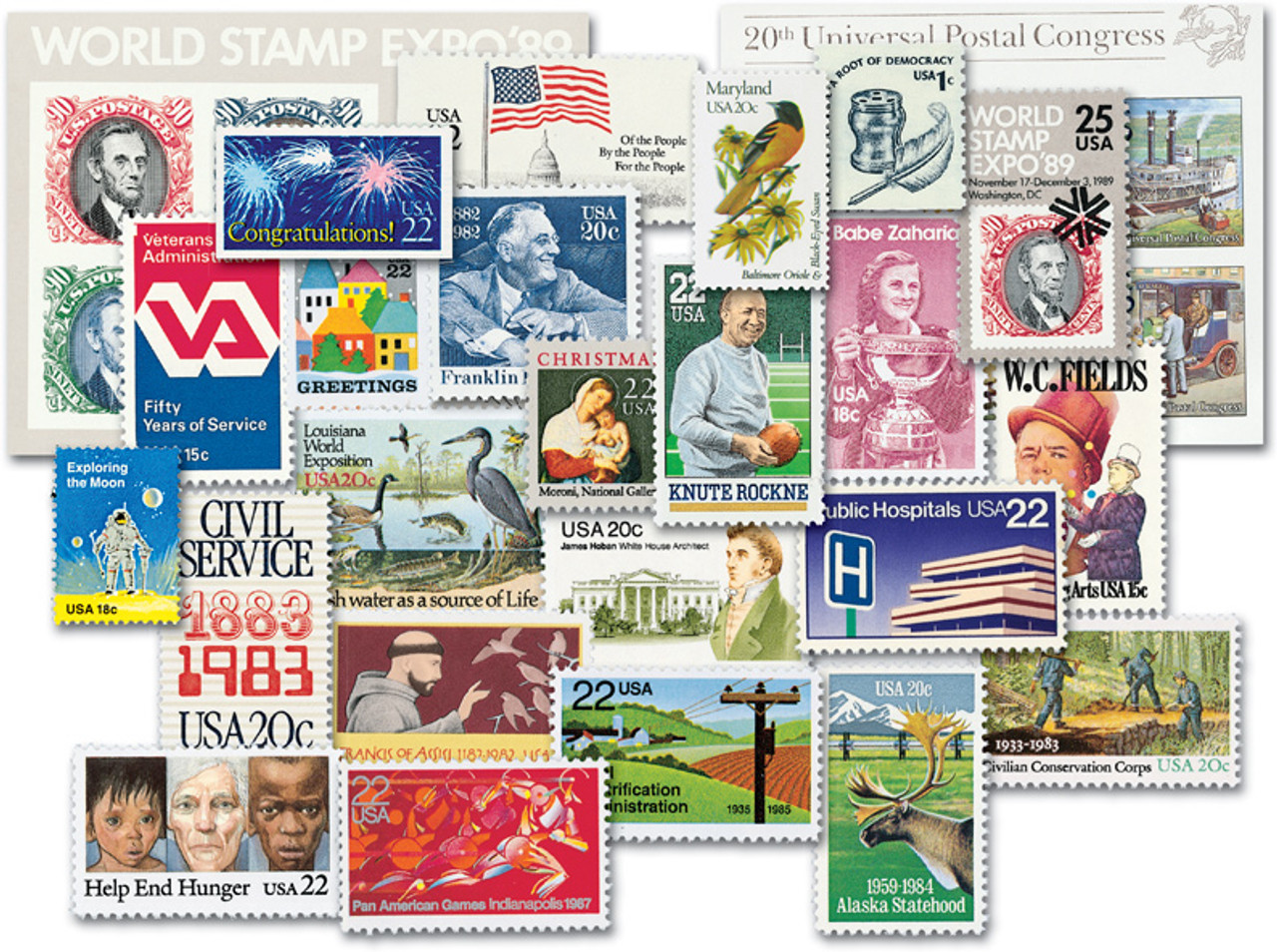
This is why you sometimes see Olympic-themed stamps from the 1980s or floral patterns from the 1990s in discount stamp packs. They are not old or fake but rather “products of their time” in large quantities.
III. Business transformation and bankruptcy resulted in a large number of unused stamps.
In the context of digital transformation, many businesses that rely on direct mail are reducing or even stopping paper communication—from law firms to wedding invitation studios.
The key point is that USPS does not collect or refund stamps that have already been sold.
Therefore, when companies clear out their inventory, they often dispose of large quantities of completely unused USPS stamps.
These stamps are usually purchased by recyclers at a discount and then enter the market, becoming one of the stable sources of discount stamp supply.

IV. Why is the discount market legal yet perplexing?
Although these stamps are completely legal, their existence in the secondary market is too “niche,” and the proliferation of fake stamp advertisements on social media makes it difficult for ordinary consumers to distinguish between genuine and counterfeit stamps.
However, a true discounted postage system is essentially a win-win-win cycle for all three parties:
Sellers: Heirs or businesses liquidate inventory, successfully monetizing dormant assets.
Distributors: Building a supply chain through recycling and distribution
Consumers: Purchase real, usable stamps at a price lower than the post office price.
This system doesn’t exploit loopholes or operate in a gray market; rather, it’s a natural result of the long-standing postage system and market behavior in the United States.
Ultimately, these discount stamps are simply resources that were purchased in advance, accumulated over many years, and are now being recirculated—truly achieving “recycling.”
V. Conclusion: Why are the discounted stamps you bought genuine?
The reason is very simple:
These originated from old inventory: collections, legacies, corporate surpluses, and hoarding by early arbitrageurs.
The Forever Stamp mechanism guarantees that it “never expires.”
The legal resale of USPS stamps has never been prohibited.
The supply chain relies on “buying early inventory at low prices,” not “selling counterfeit tickets at low prices.”
In other words, the discounts may seem “too cheap” now, but back then, their purchase cost was far lower than today’s postage.
Want to spend less money next time you send a letter?
You can browse our verified inventory of discount stamps. These discount stamps and Forever stamps are hand-picked and quality-checked to ensure that every letter you send is delivered smoothly.